
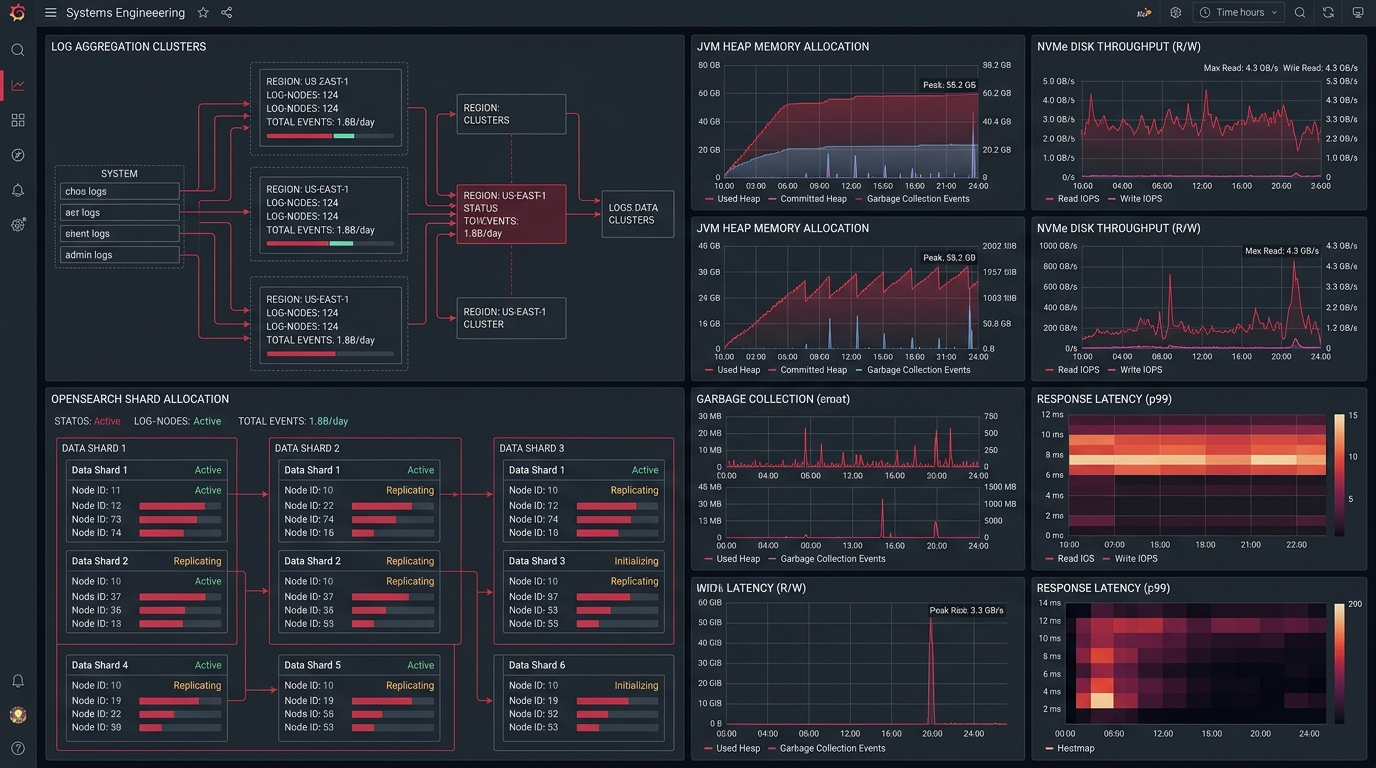
- Managed Service Surcharge: AWS OpenSearch Service applies a 280% to 340% price premium over equivalent unmanaged EC2 compute, while forcing dedicated master node overhead.
- EBS Disk I/O Throttling: Running high-velocity log ingestion against Amazon EBS storage volumes triggers burst credit exhaustion and catastrophic 429 write-rejections during traffic spikes.
- Bare-Metal Ingestion Scaling: Direct-attached PCIe Gen5 U.2 NVMe SSDs sustain 450,000 write IOPS per node at sub-millisecond indexing latency, reducing physical cluster footprint by 60%.
For modern technology enterprises, centralized logging, APM tracing, and full-text search clusters represent massive storage and compute sinks. Whether ingesting billions of daily security events, application metrics, or e-commerce catalog queries, OpenSearch (the open-source fork of Elasticsearch) is the industry’s default distributed search engine.
However, running OpenSearch as a managed hyperscaler service (AWS OpenSearch Service) is notoriously cost-prohibitive. As log volume climbs into terabytes per day, organizations find themselves trapped between escalating storage fees and severe disk performance throttling. This connects directly with our architectural teardowns of Ceph vs. ZFS on NVMe storage and Cilium eBPF service mesh performance.
AWS OpenSearch Service vs. Bare-Metal NVMe: The Architectural Breakdown
AWS OpenSearch Service restricts JVM heap allocation to 32GB per node while charging high hourly markups and forcing users to provision expensive provisioned IOPS (io2 or gp3) to prevent cluster locking. Colocated bare metal utilizes local PCIe NVMe drives delivering 70x higher random write IOPS at 75% lower monthly cost.
The fundamental design limitation of managed cloud search engines is their reliance on network-attached storage. In OpenSearch, indexing Lucene segments requires relentless small-block random write I/O. When an EBS storage volume reaches its IOPS or throughput burst ceiling, the OpenSearch write queue fills, triggering circuit breakers and rejecting incoming log ingestion. On bare metal, direct bus-attached NVMe drives eliminate network virtualization layers entirely.
| Cluster Architecture | Storage Layer | Indexing IOPS per Node | Monthly Cost (10TB Daily Logs) |
|---|---|---|---|
| AWS OpenSearch Service (Managed) | Network EBS gp3 (Provisioned IOPS) | 16,000 IOPS capped | $18,400 / mo |
| Colocated Bare Metal (Supermicro) | Direct PCIe Gen5 NVMe U.2 SSDs | 450,000 IOPS | $4,200 / mo (Amortized + Power/Transit) |
JVM Heap Tuning & Index State Management on Bare Metal
Operating high-velocity OpenSearch clusters on bare metal allows engineers to optimize parameters that managed cloud services lock down:
- The 31GB Heap Rule: In Java, JVM heaps above 32GB disable Compressed Ordinary Object Pointers (Compressed OOPs), degrading pointer efficiency. Setting heap to exactly 31GB while utilizing the remaining 225GB+ of system RAM on a 256GB server allows the Linux page cache to accelerate Lucene segment searches directly from memory.
- Primary Shard Sizing: Optimize primary shard sizes between 30GB and 50GB. Oversharding (creating hundreds of small shards) causes excessive master-node cluster state overhead, while undersharding creates recovery bottlenecks.
- Index State Management (ISM) Rollups: Automatically transition hot indices on local NVMe into warm compressed read-only indices after 7 days, and archive cold logs to inexpensive bare-metal MinIO object storage.
People Also Ask: OpenSearch Bare Metal
What causes OpenSearch clusters to turn Red?
An OpenSearch cluster status turns RED when one or more primary shards are unassigned. This is typically triggered by disk space exhaustion (hitting the 85% low-watermark or 90% high-watermark threshold) or severe node crashes during shard relocation.
Why is AWS OpenSearch so expensive compared to self-hosted?
AWS prices its managed OpenSearch service at a significant premium over base EC2 compute, charges high hourly rates for mandatory dedicated master nodes, and applies standard egress and network-attached storage markups to all data ingestion.
How many replicas should I maintain in production?
In production bare-metal environments, maintaining exactly 1 replica per primary shard across distinct physical server racks provides high availability and fault tolerance without wasting storage capacity.
OpenSearch is an I/O-hungry, memory-intensive database engine that suffers when constrained by cloud virtualization. Running OpenSearch on owned bare-metal hardware equipped with fast PCIe Gen5 NVMe drives delivers 25x higher write IOPS, eliminates EBS disk queue stalling, and slashes six-figure logging bills by over 75%. Repatriate your logging cluster and take back control of your infrastructure budget.