
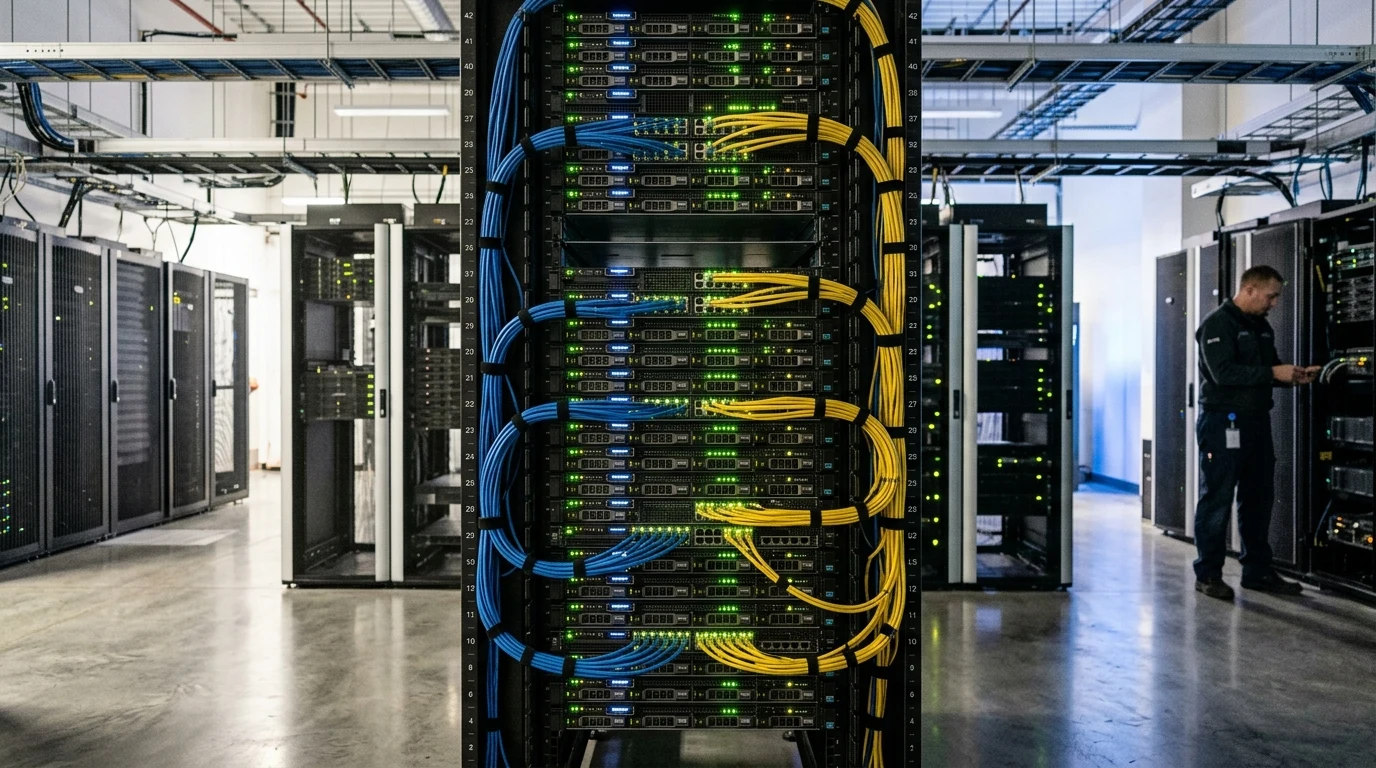
When organizations execute a cloud repatriation strategy—migrating workloads off AWS EC2 or Google Cloud Compute Engine onto colocated bare-metal hardware—the primary operational friction they encounter is server lifecycle automation. Hyperscalers have conditioned engineering teams to take sub-second API-driven VM provisioning for granted via Terraform or Pulumi. In an un-orchestrated physical data center, deploying an operating system historically meant manual USB flash drives, crash carts, and tedious Baseboard Management Controller (BMC) web GUIs.
Achieving true ‘bare-metal cloud’ agility requires building an automated, zero-touch provisioning pipeline that marries the DMTF Redfish API (for out-of-band hardware telemetry, RAID configuration, and power orchestration) with iPXE (for dynamic network booting via HTTP over 25GbE/100GbE NICs). In this technical teardown, we dissect network boot protocols, DHCP option chaining, ephemeral Linux discovery environments, and declarative operating system installation.
- Provisioning Velocity: Combining Redfish API control with HTTP-based iPXE bootstrapping provisions a 128-core AMD EPYC bare-metal host from bare silicon to a running Kubernetes worker node in under 3 minutes and 45 seconds.
- TFTP vs. HTTP Network Booting: Legacy PXE utilizes Trivial File Transfer Protocol (TFTP), which operates over UDP with small 512-byte lockstep blocks, crawling over modern 10GbE+ links. iPXE replaces TFTP with standard HTTP/HTTPS, utilizing TCP window scaling to pull 2GB OS images in seconds.
- Redfish Standardized BMC Control: Modern IPMI is deprecated due to severe security vulnerabilities and vendor-specific cipher suites. Redfish provides an encrypted RESTful JSON interface across Dell iDRAC, HP iLO, and Supermicro IPMI for hardware configuration.
What Is the Difference Between Legacy PXE and Modern iPXE?
When an unprovisioned bare-metal server boots up, its UEFI firmware initializes the network interface controller (NIC) and broadcasts a standard DHCP discover packet containing Option 93 (Client System Architecture Type). In a legacy PXE environment, the DHCP server returns Option 66 (Next Server IP) and Option 67 (Bootfile Name), pointing the host to a rudimentary TFTP server hosting a simple bootloader.
TFTP operates on a crude lockstep mechanism: the sender transmits a 512-byte packet and waits for an explicit ACK before sending the next packet. On modern 25GbE spine-leaf networks, TFTP can take 8 to 15 minutes simply to transfer a standard Ubuntu or Debian initramfs image. By contrast, iPXE chains from legacy PXE into a lightweight secondary bootloader that enables full TCP/IP networking, downloading multi-gigabyte container images and root filesystems via high-speed HTTP streams in under 12 seconds.
PXE vs iPXE Protocol Architecture Comparison
The table below compares low-level boot parameters, network capabilities, and operational constraints between legacy PXE and modern iPXE network provisioning engines:
| Provisioning Metric | Legacy PXE (1999 Standard) | iPXE (Modern Open-Source Engine) | Engineering Advantage |
|---|---|---|---|
| Transport Protocol | TFTP (UDP port 69) | HTTP / HTTPS (TCP ports 80/443) | iPXE leverages full wire speed TCP windowing |
| Boot Image Transfer Speed | 10 – 30 Mbps (Slow lockstep ACKs) | 10 – 25 Gbps (Line rate wire speed) | Reduces image transfer from 10 min to 4 sec |
| Cryptographic Security | None (Plaintext unauthenticated) | TLS / HTTPS with root CA validation | Prevents MITM image tampering on LAN |
| Dynamic Scripting | Static menu files (pxelinux.cfg) | Dynamic HTTP parameters (MAC/UUID query) | Enables database-driven declarative boots |
| SAN Boot Capabilities | Requires proprietary HBA boot ROMs | Native iSCSI and FCoE initiator | Enables completely diskless server blades |
As documented in our foundational AWS to bare-metal repatriation blueprint, building declarative infrastructure requires decoupling hardware lifecycle state from application runtimes. With iPXE, servers boot statelessly into an automated provisioning harness.
Automating BMC Management with DMTF Redfish API
Before an operating system can boot via iPXE, the server’s underlying physical hardware must be prepared. Legacy IPMI 2.0 (Intelligent Platform Management Interface) is fraught with security liabilities, including cleartext hash exposures (Cipher 0 vulnerabilities) and brittle CLI parsing with ipmitool.
The modern enterprise standard is Redfish—an open industry standard developed by the Distributed Management Task Force (DMTF). Redfish exposes a fully documented, RESTful JSON API over HTTPS directly through the server’s dedicated out-of-band management port (Dell iDRAC, HP iLO, Supermicro BMC, Lenovo XCC). An infrastructure automation engine interacts with Redfish programmatically:
1. One-Time Network Boot Override via Redfish
PATCH /redfish/v1/Systems/1 HTTP/1.1
Content-Type: application/json
Authorization: Basic YWRtaW46cGFzc3dvcmQ=

{
  "Boot": {
    "BootSourceOverrideTarget": "Pxe",
    "BootSourceOverrideMode": "UEFI",
    "BootSourceOverrideEnabled": "Once"
  }
}
2. Hardware Configuration and Storage Automation
Through Redfish, engineers automate hardware-level pre-flight configurations without touching human hands:
- BIOS Performance Tuning: Disabling C-states, setting CPU governor to maximum performance, and enabling SRIOV and VT-d virtualization extensions.
- NVMe / RAID Controller Setup: Querying physical disks and initializing hardware RAID-1 mirror arrays across dual enterprise M.2 boot drives.
- Firmware Baseline Compliance: Checking BIOS, NIC, and drive microcode versions against an enterprise security catalog and flashing updates out-of-band.
The Zero-Touch Provisioning Architecture: Step-by-Step Flow
A production-grade bare-metal provisioning workflow (modeled after systems like Tinkerbell, Canonical MAAS, or custom Go services) operates in five distinct automated stages:
- Discovery Boot: The new server powers on, receives an ephemeral IP via DHCP, and loads a generic iPXE binary. iPXE executes an HTTP GET to
http://provisioner.internal/boot.ipxe?mac=${net0/mac}. - Hardware Inspection Agent: The provisioner returns an iPXE script instructing the host to boot an in-memory Alpine Linux or Debian micro-kernel. This inspection agent probes lshw, nvme list, and dmidecode, posting the server’s exact CPU core count, RAM topology, and drive serials back to the infrastructure database.
- Declarative OS Installation: Once the hardware profile is validated against the inventory specification, the server receives its target installation script. Using cloud-init or Talos Linux configurations, the installer streams the root filesystem image directly to the NVMe storage array, configures static IP bonding, and injects root SSH keys.
- BMC Re-Configuration: Redfish clears the one-time PXE boot flag, setting the primary boot device permanently to local NVMe UEFI storage.
- Reboot to Production: The server reboots into its native Linux operating system, joins the Kubernetes cluster or Ceph storage pool, and reports healthy telemetry within 4 minutes.
Do not attempt bare-metal cloud repatriation by treating servers like pets with manual installations. Build your out-of-band automation first. Redfish API plus HTTP-based iPXE booting provides a rock-solid, vendor-agnostic foundation that completely eliminates crash carts and delivers the exact same API-driven developer velocity as public cloud compute instances, at less than one-fifth the operational TCO.