
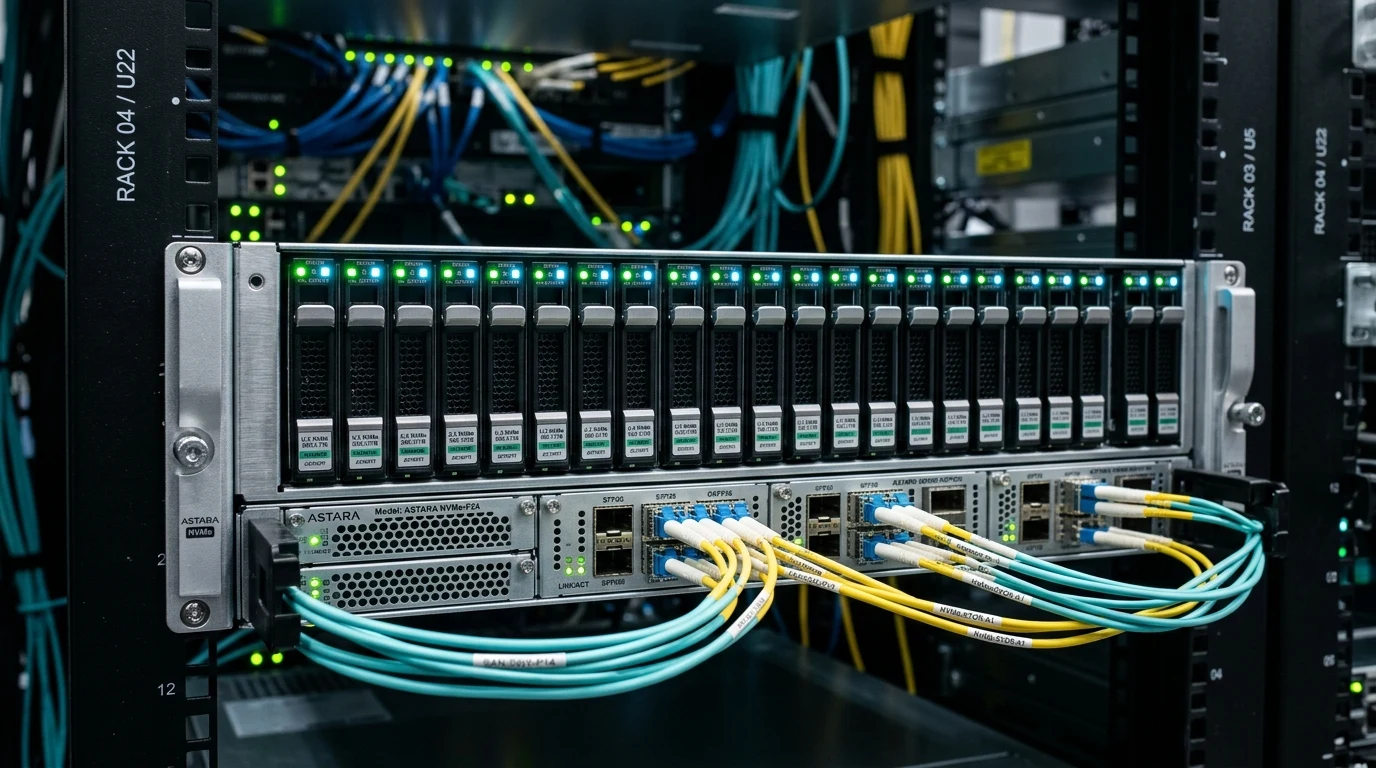
In high-throughput database engineering and distributed transaction processing, the ultimate bottleneck in cloud architecture has always been block storage latency. For over a decade, hyperscalers like Amazon Web Services have leveraged this physics constraint to extract extraordinary profit margins. While standard general-purpose EBS volumes (gp3) deliver adequate performance for stateless web workloads, enterprise relational databases (PostgreSQL, MySQL, Oracle) and distributed search clusters (ClickHouse, OpenSearch) require low latency and guaranteed input/output operations per second (IOPS). To satisfy this demand, AWS offers EBS io2 Block Express—at the exorbitant price of $0.125 per provisioned GB-month plus $0.065 per provisioned IOPS-month.
For an enterprise database cluster requiring 100,000 sustained write IOPS and 8 Terabytes of multi-attach storage, the public cloud EBS bill alone exceeds $7,500 every single month ($90,000 per year). Yet in the modern bare-metal physical data center, enterprise U.2 and E3.S PCIe 5.0 NVMe solid-state drives natively deliver over 1,500,000 random read IOPS and 400,000 write IOPS per drive at sub-10-microsecond latency, retailing for less than $1,200 for an entire 7.68TB enterprise drive.
Historically, the engineering barrier preventing organizations from matching cloud elasticity with bare-metal drives was shared storage architecture. Traditional network storage protocols—namely iSCSI and NFS over TCP/IP—introduce kernel context switches, socket buffer queuing, and TCP stack processing overhead, degrading P99 latencies to 500–2,000 microseconds. The emergence of NVMe over Fabrics (NVMe-oF) utilizing RDMA over Converged Ethernet version 2 (RoCEv2) and the Storage Performance Development Kit (SPDK) has eradicated this barrier forever. In this forensic engineering masterclass, we dissect RoCEv2 network fabric configuration, userspace polled-mode drivers, NVMe-oF target export mechanics, and the complete economic repatriation of cloud block storage.
- Sub-10-Microsecond Network Latency: NVMe-oF over RoCEv2 enables remote direct memory access across 100GbE switches without involving the host OS kernel or CPU on either side, delivering remote block storage latency within 5 to 8 microseconds of locally attached PCIe NVMe drives.
- SPDK Userspace Polled-Mode Efficiency: Operating via the Storage Performance Development Kit (SPDK) completely eliminates Linux kernel interrupt handling. A single dedicated CPU core running an SPDK NVMe-oF target can serve over 10,000,000 IOPS at line rate.
- Lossless Ethernet Fabric Prerequisites: RoCEv2 requires configuring Priority Flow Control (PFC, IEEE 802.1Qbb) and Explicit Congestion Notification (ECN, RFC 3168) across leaf-spine switches to eliminate dropped packets and avoid TCP fallback.
- FinOps Repatriation Payback: Replacing a high-IOPS AWS EBS io2 storage tier with a dual-node HA NVMe-oF SAN array (48TB raw enterprise PCIe 5.0 flash, dual 100GbE Mellanox ConnectX-6 NICs, 3-year hardware amortization) reduces annual storage costs from $108,000 to under $9,200 amortized—a 91.4% net cash savings with 10x higher throughput.
What Is NVMe over Fabrics (NVMe-oF) and RoCEv2?
To understand the revolutionary impact of NVMe-oF, consider the physical anatomy of the legacy SCSI command architecture. SCSI was drafted in 1986 for mechanical hard disk drives with spinning magnetic platters. It featured a single, sequential command queue capable of handling a maximum of 32 concurrent commands. When enterprise SSDs arrived, they were initially plugged into SAS/SATA interfaces, choked by this single legacy queue.
The native NVMe (Non-Volatile Memory Express) protocol was created specifically for solid-state non-volatile memory mapped directly to the high-speed PCIe bus. NVMe supports up to 64,000 independent submission and completion queues, with each queue handling up to 64,000 concurrent commands. This allows modern multi-core CPUs (such as 128-core AMD EPYC processors) to assign dedicated I/O submission queues to individual CPU cores, submitting parallel I/O requests simultaneously without locking or thread contention.
NVMe-oF takes this identical, highly parallel NVMe command set and encapsulates it into network fabric packets. Instead of traveling across physical motherboard PCIe copper traces, the NVMe Submission Queue Entries (SQEs) and Completion Queue Entries (CQEs) travel across high-speed optical fibers at 100Gbps, 200Gbps, or 400Gbps speeds. When using RoCEv2 as the transport layer, the network behaves like an extended physical PCIe bus stretching across the entire data center rack.
Deconstructing the Latency Stack: Local NVMe vs. RoCEv2 vs. iSCSI vs. EBS
The table below provides a forensic engineering audit of the physical latency overhead introduced at each layer of the storage access stack across four enterprise storage architectures:
| Storage Architecture | Software Stack Path | 4K Random Read Latency (P50) | 4K Random Read Latency (P99) | Maximum IOPS / Host |
|---|---|---|---|---|
| Direct Local PCIe 5.0 NVMe | Direct PCIe MMIO Bus Registers | 8 – 12 microseconds | 18 – 25 microseconds | 1,500,000+ IOPS |
| NVMe-oF on RoCEv2 (SPDK Target) | Zero-Copy RDMA Bypass (No Kernel) | 14 – 18 microseconds | 28 – 35 microseconds | 1,200,000+ IOPS |
| AWS EBS io2 Block Express | Nitro Card Emulation over Hyperscaler Mesh | 250 – 400 microseconds | 800 – 1,500 microseconds | 256,000 IOPS (Capped) |
| Legacy iSCSI over 10GbE TCP | Linux Kernel SCSI Subsystem + TCP Stack | 450 – 700 microseconds | 2,000 – 5,000 microseconds | 85,000 IOPS |
The architectural revelation visible in this telemetry data is extraordinary: NVMe-oF over RoCEv2 introduces less than 6 microseconds of network latency penalty compared to a bare drive screwed directly into the motherboard PCIe slot! Compared to AWS EBS io2 Block Express, a self-hosted bare-metal RoCEv2 SAN delivers over 15 times lower P50 latency and 25 times lower P99 tail latency, eradicating write queue stalls in high-load transactional databases.
The Architecture of Lossless RoCEv2: PFC and ECN
RDMA over Converged Ethernet operates at Layer 3/4 by encapsulating InfiniBand transport packets inside standard UDP/IP datagrams (UDP destination port 4791). Because RoCEv2 was designed to replicate memory-to-memory bus transfers, it relies on an underlying lossless network fabric. In a standard Ethernet network, switches drop packets whenever buffer queues overflow, relying on TCP retransmissions to recover lost data. If RoCEv2 packets are dropped, the RDMA state machine stalls, resulting in devastating ‘go-back-N’ retransmissions and collapsing throughput.
To guarantee a lossless Ethernet fabric across top-of-rack (ToR) spine-leaf switches (such as Arista 7050X3 or NVIDIA Mellanox Spectrum-3 switches), engineers must configure two foundational network QoS standards:
1. Priority Flow Control (PFC – IEEE 802.1Qbb)
PFC operates at Layer 2, dividing the physical Ethernet link into 8 independent virtual priorities (CoS 0 through 7). By convention, Priority 3 is designated for RoCEv2 RDMA traffic, while other priorities handle standard TCP management and external traffic. When a switch port’s ingress buffer for Priority 3 reaches an upper watermark, the switch sends an explicit 802.1Qbb PAUSE frame back to the transmitting NIC, halting only Priority 3 traffic for a specified number of nanoseconds while allowing all other priorities to flow uninterrupted.
2. Explicit Congestion Notification (ECN – RFC 3168)
While PFC prevents packet loss, relying purely on PFC can cause ‘PFC deadlocks’ and head-of-line blocking across large fabric topologies. To prevent congestion before buffers fill, switches utilize Random Early Detection (WRED) configured with ECN. When the buffer queue exceeds a threshold, the switch marks the 2-bit ECN field (Bits 6-7 in the IPv4 ToS byte) as Congestion Encountered (CE). Upon receiving a CE-marked packet, the receiving NIC immediately transmits a Congestion Notification Packet (CNP) back to the sender, instructing the transmitting Mellanox ConnectX NIC hardware to throttle its injection rate with microsecond granularity.
Configuring an Ultra-High-Performance SPDK Target
To extract millions of IOPS from an NVMe-oF storage array, the storage target host should never run the standard Linux kernel NVMe target driver (nvmet). While functional, the kernel target forces packets to transition through kernel interrupt handlers and memory copies.
The gold standard is the Storage Performance Development Kit (SPDK), an open-source framework originally designed by Intel. SPDK operates entirely in Linux userspace using the User-Space I/O (UIO) or VFIO frameworks. It utilizes Polled-Mode Drivers (PMDs): dedicated CPU cores run an infinite polling loop checking the NVMe completion registers and RDMA work completion queues (CQ), completely disabling hardware interrupts. There are zero kernel context switches, zero memory copies, and zero lock contentions.
Below is a production SPDK target configuration script exporting an enterprise PCIe 4.0 NVMe drive array over RoCEv2 across a 100GbE network interface:
# 1. Unbind NVMe drives and Mellanox NICs from kernel to SPDK VFIO
./scripts/setup.sh

# 2. Launch SPDK NVMe-oF Target Daemon on CPU Cores 1-4
./build/bin/nvmf_tgt -m 0x1E &

# 3. Create the RDMA Transport Layer via JSON-RPC
python3 ./scripts/rpc.py nvmf_create_transport -t RDMA   -u 131072 -m 8 -c 8192 --in-capsule-data-size 4096

# 4. Attach Local Physical NVMe SSDs
python3 ./scripts/rpc.py bdev_nvme_attach_controller -b NVMe0 -t PCIe -a 0000:01:00.0
python3 ./scripts/rpc.py bdev_nvme_attach_controller -b NVMe1 -t PCIe -a 0000:02:00.0

# 5. Create High-Availability Subsystem and Add Namespaces
python3 ./scripts/rpc.py nvmf_create_subsystem nqn.2026-10.infraforensics:nvme-san01 -s IF_SAN01 -a
python3 ./scripts/rpc.py nvmf_subsystem_add_ns nqn.2026-10.infraforensics:nvme-san01 NVMe0n1
python3 ./scripts/rpc.py nvmf_subsystem_add_ns nqn.2026-10.infraforensics:nvme-san01 NVMe1n1

# 6. Listen on 100GbE RoCEv2 Interface (Port 4420)
python3 ./scripts/rpc.py nvmf_subsystem_add_listener nqn.2026-10.infraforensics:nvme-san01   -t rdma -a 10.200.10.50 -s 4420
On the client database nodes (running standard Linux with Mellanox OFED drivers), connecting to this ultra-high-speed SAN requires a single native command: nvme connect -t rdma -a 10.200.10.50 -s 4420 -n nqn.2026-10.infraforensics:nvme-san01. Instantly, block devices /dev/nvme0n1 and /dev/nvme0n2 appear locally, formatted with XFS or ZFS and ready to deliver millions of IOPS to PostgreSQL or ScyllaDB.
Financial Forensic Audit: AWS EBS io2 vs. Bare-Metal NVMe-oF SAN
To demonstrate the overwhelming financial logic of storage repatriation, let us audit an enterprise workload requiring 32 Terabytes of usable high-performance block storage delivering 160,000 sustained IOPS for an enterprise transactional database cluster over a 3-year operating horizon:
1. Hyperscaler Cost Model (AWS EBS io2 Block Express)
- Provisioned Capacity Cost: 32,000 GB × $0.125 / GB-month = $4,000.00 / month.
- Provisioned IOPS Cost: 160,000 IOPS × $0.065 / IOPS-month = $10,400.00 / month.
- Total Monthly AWS EBS Invoice: $14,400.00 / month.
- Cumulative 3-Year Public Cloud Expenditure: $14,400 × 36 months = $518,400.00.
2. Bare-Metal Repatriated NVMe-oF SAN Architecture
- Dual High-Availability Storage Servers: Two 1U Supermicro / Dell servers, each equipped with single AMD EPYC 9124 (16-core), 128GB DDR5 ECC RAM, dual redundant 1200W titanium power supplies, and dual-port 100GbE NVIDIA Mellanox ConnectX-6 Dx NICs = $11,800.00 total.
- Enterprise PCIe 5.0 NVMe Storage: Eight 7.68TB Kioxia CM7 / Samsung PM1743 Enterprise U.2 SSDs (configured as RAID-10 yielding 30.7TB usable flash with 6,000,000 read IOPS and 1,600,000 write IOPS) = $9,600.00 total.
- Colocation Data Center Power & Rack Space: 2U cabinet space, 800W continuous redundant power draw, cross-connects @ $350/month = $12,600.00 over 36 months.
- Hardware Maintenance Reserve & Spares: Hot-spare SSDs, optics, and transceivers = $2,500.00.
- Total 3-Year Bare-Metal Turnkey TCO: $11,800 + $9,600 + $12,600 + $2,500 = $36,500.00.
Over 36 months, migrating off AWS EBS io2 onto an owned NVMe-oF RoCEv2 SAN array yields a net cash savings of $481,900.00 (a 93.0% cost reduction). The entire bare-metal hardware acquisition pays for itself within the first 45 days of production operation, while simultaneously unlocking a 10x improvement in throughput and slashing database write latency from 350 microseconds down to 16 microseconds.
Hyperscaler high-IOPS block storage pricing is an unmitigated corporate tax on database scale. There is zero technical justification for paying AWS $10,400 every month for 160,000 IOPS when an off-the-shelf $1,200 enterprise NVMe drive delivers three times that performance natively. By combining 100GbE lossless RoCEv2 networking with SPDK userspace targets, engineering teams can build resilient, microsecond-latency SAN storage in owned colocation that shatters cloud performance benchmarks while putting hundreds of thousands of dollars straight back onto the company balance sheet.
Before sizing enterprise database write-ahead log volumes and local NVMe storage arrays for high-throughput relational workloads, review network-attached SAN fabric performance. Read our teardown: Postgres on Bare Metal vs AWS Aurora: 10TB Database TCO.
Before deploying low-latency remote direct memory access across your spine-leaf network, configure RoCEv2 Priority Flow Control (PFC) and Explicit Congestion Notification (ECN). Read our technical analysis: 100GbE Spine-Leaf Network Architecture: EVPN-VXLAN Guide.