
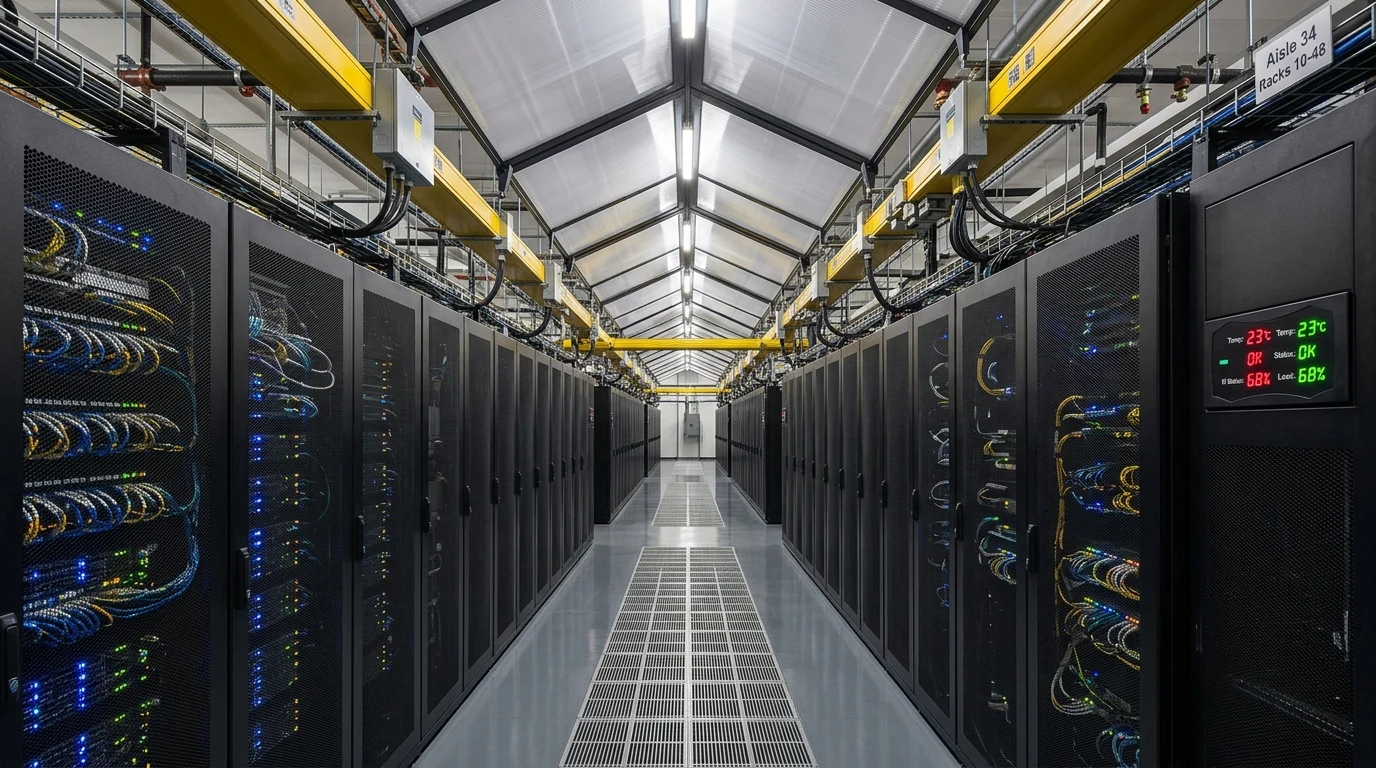
When enterprise infrastructure teams evaluate migrating off hyperscalers onto owned bare metal, the financial modeling often fixates exclusively on server capital expenditures (CapEx)—the cost of CPUs, NVMe SSDs, and DDR5 memory modules. However, in physical infrastructure architecture, long-term operational expenditures (OpEx) are governed by a different metric: data center power density and Power Usage Effectiveness (PUE).
Colocation providers (Equinix, Digital Realty, Cyxtera, CoreSite) do not charge primarily for physical floor space; they charge for contracted electrical power capacity (in kilowatts) and cooling overhead. A standard 42U rack enclosure is virtually free compared to the electrical infrastructure required to energize and cool it. If an engineering team contracts for 15 kW of power but only draws 6 kW due to poor hardware density, they pay for thousands of dollars in ‘stranded power capacity’ every month. In this forensic audit, we model PUE energy multipliers, hot-aisle vs cold-aisle containment, high-density 20kW+ rack economics, and utility power pass-through contracts.
- The PUE Energy Tax: Power Usage Effectiveness (PUE) measures the ratio of total facility power to actual IT equipment power:
PUE = Total Facility Power / IT Equipment Power. In an older facility with a PUE of 1.65, 39% of your monthly power bill goes strictly to facility chillers, transformers, and UPS losses. - Modern High-Efficiency Baseline: Modern colocation facilities utilizing direct evaporative cooling and hot-aisle containment achieve PUE ratings of 1.15 to 1.25, slashing cooling overhead costs by more than half.
- High-Density vs Low-Density Economics: Consolidating 40 servers into a single 20 kW high-density rack cabinet saves over $1,800/month compared to spreading those same servers across four legacy 5 kW racks, eliminating redundant cabinet fees and cross-connect charges.
What Is Power Usage Effectiveness (PUE) and Why Does It Matter for FinOps?
When negotiating a Colocation Master Service Agreement (MSA), billing models typically fall into two categories: flat-rate breakered power or metered power with a PUE multiplier. In metered contracts, the facility bills the enterprise for the exact kilowatt-hours consumed by their server power supply units (PSUs), multiplied by the facility’s contracted PUE ratio:
Monthly Power Invoice = (IT kWh Consumed) × (Contracted PUE) × (Utility Rate per kWh)
Example: 10,000 kWh IT draw × 1.55 PUE × $0.14/kWh = $2,170.00 billed
At a modern 1.18 PUE: 10,000 kWh IT draw × 1.18 PUE × $0.14/kWh = $1,652.00 billed
Monthly Savings from PUE alone: $518.00 / month ($6,216 / yr per 10 kW)
Over a multi-rack deployment consuming 60 kW of continuous compute, the difference between an efficient 1.18 PUE facility and a legacy 1.60 PUE facility represents over $38,000 in pure cooling waste every year.
PUE Efficiency & Rack Density Financial Modeling
The table below models monthly and 3-year operational expenditures for hosting 40 high-density 1U dual-socket AMD EPYC servers (consuming a total of 16 kW continuous IT load at $0.13/kWh utility power) across different facility efficiency profiles and rack density topologies:
| Colocation Facility Profile | PUE Rating | Rack Topology | Monthly OpEx (Power + Space) | 3-Year Cumulative OpEx |
|---|---|---|---|---|
| Legacy Tier II Facility | 1.65 PUE (Perimeter CRAC units) | 4 Racks @ 4 kW / rack | $4,820 / month | $173,520 |
| Standard Tier III Colocation | 1.35 PUE (Cold aisle curtains) | 2 Racks @ 8 kW / rack | $3,410 / month | $122,760 |
| Modern High-Density Facility | 1.18 PUE (Hot Aisle Containment) | 1 Single 20 kW Rack | $2,480 / month | $89,280 (48.5% Total Savings) |
As demonstrated in our analysis of bare-metal repatriation blueprints, hardware placement strategy is just as vital as server purchasing. Consolidating into a single modern 20 kW cabinet with a 1.18 PUE saves $84,240 over three years compared to spreading across four legacy low-density cabinets.
The Physics of Hot-Aisle Containment (HAC)
Why do modern facilities achieve dramatically lower PUE numbers? The engineering answer lies in airflow segregation. In legacy data centers, servers drew cold air from a raised floor plenum and exhausted hot air (105°F–120°F) into the room. Because the room was an open shared space, hot exhaust air circulated around the sides and tops of cabinets, mixing with the chilled supply air. To keep server inlet temperatures below the ASHRAE A1 recommended limit of 80.6°F (27°C), chillers had to blast sub-60°F air into the room, running compressors constantly at massive thermodynamic penalties.
Modern high-density data centers utilize Hot-Aisle Containment (HAC):
- Physical Isolation Barriers: The rear exhaust corridor of the cabinet row is completely enclosed with ceiling panels and self-closing double doors.
- Eliminating Air Recirculation: Hot server exhaust cannot escape into the room. It is drawn directly upward into overhead return plenums by variable-frequency drive (VFD) fans.
- Elevated Chilled Water Temperatures: Because supply air never mixes with hot exhaust, the facility can supply 75°F (24°C) air to the server front faces, allowing chillers to operate in energy-saving ‘economizer / free-cooling’ mode for up to 8 months of the year in temperate climates.
Avoiding the Stranded Power Trap: Right-Sizing Rack Feeds
Under the National Electrical Code (NEC Article 210.20), electrical branch circuits feeding continuous loads cannot be loaded beyond 80% of their rated breaker capacity:
- Single-Phase 120V 20A Circuit: 120V × 20A × 0.80 = 1,920 Watts usable. Totally obsolete for enterprise compute; a single 4-GPU server exceeds this limit.
- Single-Phase 208V 30A Circuit: 208V × 30A × 0.80 = 4,992 Watts (5 kW) usable. Common in older colocation suites, but severely restricts modern server packing to 10–12 nodes per rack.
- Three-Phase 208V 30A Wye Circuit: 208V × 30A × 1.732 × 0.80 = 8,646 Watts (8.6 kW) usable.
- Three-Phase 208V 60A / 415V 30A Feed: Delivers 17.3 kW to 21.5 kW of usable continuous power to a single rack, enabling complete consolidation of 40 dense compute nodes or multi-GPU AI training clusters.
When shopping for colocation, never negotiate based on square footage or rack unit count—negotiate based on contracted kilowatt density and certified facility PUE. Insist on high-density hot-aisle contained cabinets capable of delivering 15 kW to 20 kW with a sub-1.20 PUE. Packing your compute tightly into fewer high-power cabinets cuts your facility overhead in half and eliminates the silent FinOps profit killer: paying for stranded, unutilized power breakers.
Before repatriating enterprise telemetry clusters and dedicated time-series monitoring engines to owned hardware, evaluate power density and rack cooling dynamics. Read our audit: AWS CloudWatch Pricing Trap: Slashing Log Ingestion Costs.