- The Cloud Markup Reality: For mid-market SaaS platforms and data-intensive engineering organizations spending between $20,000 and $100,000 monthly on hyperscale cloud providers (AWS/GCP), up to 45% of gross infrastructure expenditure is consumed by artificial rent-seeking tolls—principally $0.045/GB Managed NAT Gateway data processing fees, $0.01/GB cross-Availability Zone transit taxes, and $0.05–$0.09/GB internet data transfer out (egress).
- Hardware Amortization Economics: Modern enterprise silicon—such as dual-socket AMD EPYC 9004/9654 processors (192 execution threads, 1.5TB DDR5 ECC memory, and enterprise U.2 PCIe 5.0 NVMe arrays delivering 1.8M IOPS)—can be procured, racked, and fully capitalized for less than the cost of 10 to 14 months of equivalent AWS EC2 reserved instances. Over a standard 36-to-48 month hardware amortization cycle, bare-metal operations yield 65% to 75% gross margin reductions.
- Modern Bare-Metal Operational Parity: The historical counter-argument to colocation—requiring armies of system administrators to manage cables and OS disks—is obsolete. Utilizing immutable Linux distributions (Talos Linux), declarative GitOps automation (FluxCD / ArgoCD), and Cilium eBPF networking, engineering teams operate bare-metal clusters with identical operational ergonomics to managed cloud services (EKS).
- Strategic Cloud Hybridization: Successful repatriation does not mean ideological purity. High-velocity engineering teams maintain a lean public cloud presence for edge DNS (Route 53), CDN edge distribution (Cloudflare / CloudFront), and secondary immutable S3 Glacier deep backups, while migrating the steady-state computing core and database state to dedicated silicon.
Over the past decade, enterprise IT leaders were fed an unquestioned dogma: running infrastructure in hyperscale public clouds was cheaper, more reliable, and inherently faster than operating physical hardware. Today, that narrative has collided with the balance sheet. For high-growth startups and established enterprise engineering teams running predictable, steady-state workloads, public cloud platforms have transformed from an agile operational lever into an extractive financial tollbooth.
The economics of aws to bare metal repatriation are not driven by nostalgia; they are driven by cold, fiduciary arithmetic. When 37signals (Basecamp / HEY) published their landmark repatriation audit demonstrating $3.2 million in projected savings over five years after exiting AWS, it catalyzed an industry-wide reckoning. For mid-tier engineering companies processing moderate-to-high data throughput, migrating from Amazon Web Services to dedicated colocation or bare-metal leasing unlocks over $180,000 in immediate annual cost recovery. This blueprint outlines the exact financial forensics, hardware bill of materials, network topology, and software orchestration required to execute a zero-downtime bare-metal repatriation.
1. Forensic Cloud Billing Audit: Deconstructing the Hyperscaler Rent-Seeking Traps
To understand why bare metal delivers such staggering financial returns, one must conduct a forensic line-item audit of a standard AWS enterprise bill. Hyperscale cloud pricing is deliberately architected to make compute seem accessible while taxing every byte of data that moves through internal networking boundaries.
Consider the three primary predatory network taxes embedded in AWS virtual private clouds (VPCs):
| AWS Billing Component | AWS Hyperscale Pricing Model | Bare-Metal Colocation Reality | Annual Markup Multiplier |
|---|---|---|---|
| AWS Managed NAT Gateway | $0.045/hour base + $0.045 per GB processed | $0.00 / GB (Handled via Linux iptables/nftables on redundant gateway routers) | Infinite / Pure Profit (A 50TB/mo outbound pipeline costs $2,250/mo on AWS solely for NAT packet translation). |
| Cross-AZ Data Transit | $0.01 per GB in + $0.01 per GB out ($0.02/GB round-trip) | $0.00 (Unmetered 25GbE / 100GbE local switching fabric across top-of-rack switches) | Pure Artificial Friction (Penalizes high-availability multi-zone database replication by thousands of dollars monthly). |
| Internet Data Transfer Out (Egress) | $0.09 per GB (down to $0.05/GB at 150TB scale) | $0.50 – $1.20 per Mbps committed burstable transit (Roughly $0.0015 to $0.003 per GB) | 30x to 60x Markup over raw Tier-1 carrier transit costs (Cogent, Telia, Lumen, HE). |
| EBS Provisioned IOPS (gp3 / io2) | $0.08/GB-mo storage + $0.005/provisioned IOPS + $0.04/MB/s throughput | Direct-attached Enterprise NVMe Gen5 (Samsung PM1743 / Micron 9400) | 8x to 15x Premium for 1/10th the real-world IOPS and 5x higher tail latency. |
When an engineering team builds microservices inside an AWS VPC across multiple Availability Zones, traffic flowing from Kubernetes pods to a managed RDS PostgreSQL cluster crosses AZ boundaries, incurring $0.02/GB round-trip. When worker nodes pull Docker containers from external registries or sync assets with external APIs, traffic passes through an AWS NAT Gateway, triggering another $0.045/GB penalty. Before a single customer payload is delivered over the public internet, internal infrastructure plumbing has already extracted an exorbitant toll.
2. Hardware Bill of Materials (BOM): Enterprise Silicon vs. EC2 Instances
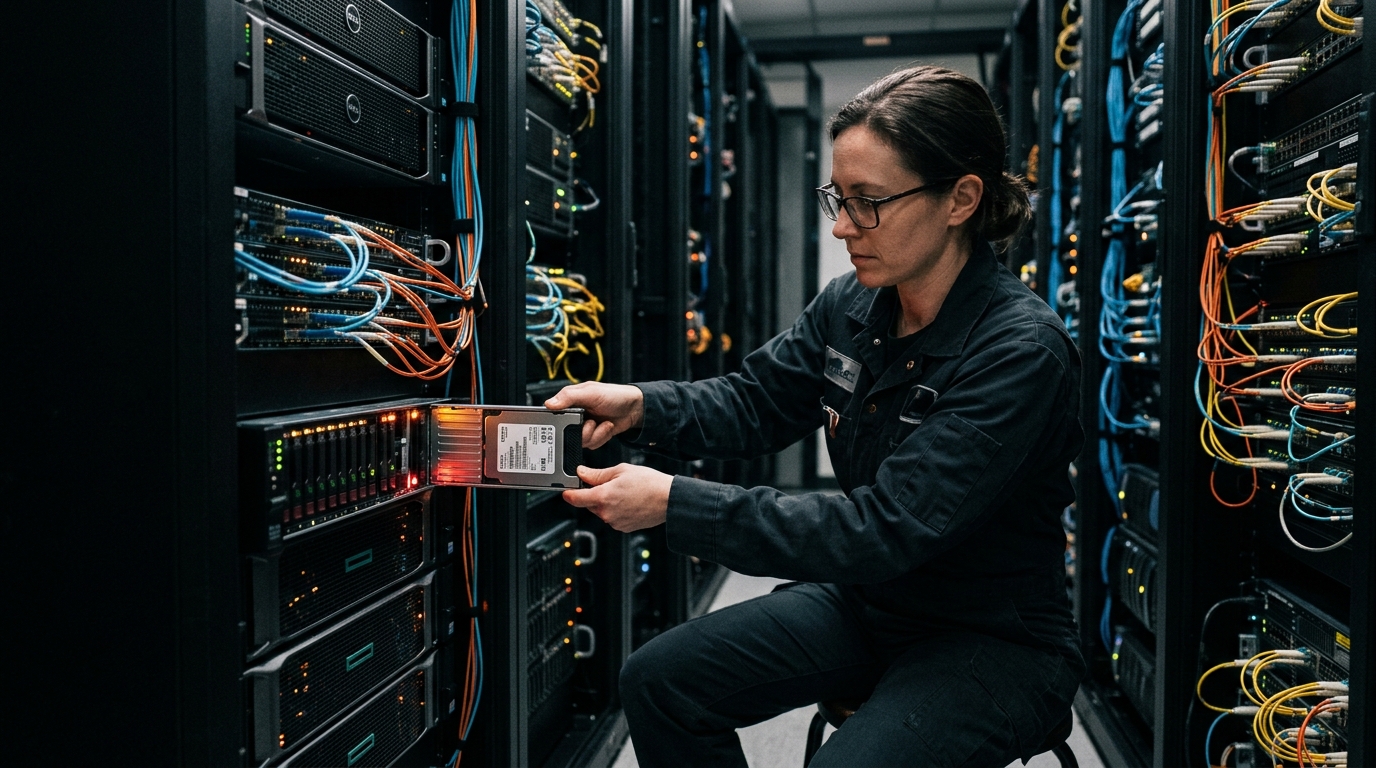
In bare-metal architecture, you do not rent hypervisor-sliced vCPUs subject to noisy-neighbor throttling and memory bus contention. You own or lease physical silicon with dedicated memory channels, massive L3 caches, and zero virtualization overhead.
To replace an AWS deployment consuming approximately 120 vCPUs, 512GB of RAM, and 20TB of high-IOPS database storage (typically provisioned as 2x r6i.4xlarge database instances, 4x c6i.4xlarge application nodes, and multiple load balancers costing ~$16,500/mo on AWS), we engineer a high-density 4-node cluster:
| Server Node Role | Hardware Specifications (Dell PowerEdge / Supermicro) | Capital Cost (CapEx) | Monthly Equivalent Amortization (36-Mo) |
|---|---|---|---|
| 2x Primary Database Nodes (Master + Replica) | Dual AMD EPYC 9354 (64 Cores / 128 Threads), 768GB DDR5-4800 ECC, 4x 7.68TB Enterprise NVMe Gen4 (RAID-10), Dual 25GbE Mellanox ConnectX-6 | $24,800 ($12,400 per node) | $688.88 / month |
| 2x Compute Worker Nodes (Kubernetes Workers) | Dual AMD EPYC 9554 (128 Cores / 256 Threads), 512GB DDR5 ECC, 2x 3.84TB NVMe OS/Cache, Dual 25GbE Mellanox NICs | $21,600 ($10,800 per node) | $600.00 / month |
| Top-of-Rack Network Fabric | 2x Arista 7050SX3-48YC8 (48x 25GbE SFP28 + 8x 100GbE QSFP28 Uplinks) in MLAG high-availability pair | $9,500 (Refurbished enterprise certified) | $263.88 / month |
| Out-of-Band & Firewall Appliances | 2x Netgate 6100 pfSense Plus firewalls in CARP HA + Opengear Console Server | $4,200 | $116.66 / month |
| Total Hardware Capital Expenditure | Full Redundant 4-Node 192-Core Enterprise Stack | $60,100 | $1,669.42 / month |
The entire physical server cluster—delivering 192 physical CPU cores, 384 threads, 2.5TB of high-speed DDR5 RAM, and over 20TB of enterprise NVMe storage capable of 1.4 million random 4K write IOPS at sub-80 microsecond latencies—costs $60,100 to purchase outright. That represents less than 4 months of the equivalent AWS monthly run-rate.
3. Colocation Facilities & Carrier Network Architecture
Modern bare-metal hosting does not mean keeping servers in an office closet. Infrastructure is deployed into Tier III or Tier IV carrier-neutral colocation facilities (such as Equinix, Digital Realty, CoreSite, or Cyxtera) with N+1 or 2N redundant UPS power, diesel backup generators, and biometric security.
Colocation Space & Power Contract: A standard quarter-rack (10U to 12U) or half-rack (20U) with redundant A/B 20A 208V power feeds (providing 3.3 kW of usable power) averages between $1,200 and $1,800 per month in major metropolitan interconnect markets (Northern Virginia, Chicago, Dallas, Silicon Valley).
Blended IP Transit Economics: Rather than paying AWS $0.09 per gigabyte of egress, colocation operators purchase blended multi-homed IP transit (combining Tier-1 carriers such as Lumen, Telia/Arelion, Cogent, and Hurricane Electric). A committed 1 Gbps unmetered port costs between $400 and $700 per month. A 1 Gbps unmetered pipeline can push up to 324 Terabytes of egress traffic every month for a flat $500 fee. On AWS, pushing 324TB of egress through CloudFront or internet gateways incurs over $16,200 in monthly bandwidth charges alone.
4. Modern Software Orchestration: Talos Linux, Kubernetes & Cilium eBPF
The single greatest operational barrier that kept engineering teams trapped in public cloud ecosystems was the fear of bare-metal management overhead: PXE booting, disk partitioning, SSH keys, configuration drift, and kernel patching. In 2026, this operational friction has been eliminated by immutable operating systems.
The modern bare-metal software stack utilizes three core pillars:
- Talos Linux (Immutable Kubernetes OS): Talos is a hardened, minimal, immutable Linux distribution designed exclusively for Kubernetes. It has no shell, no SSH daemon, no package manager, and no interactive console. The entire operating system is defined by a single declarative YAML machine configuration file. Upgrades to Kubernetes and the underlying Linux kernel are executed as atomic, rolling, API-driven image swaps. If a server node misbehaves, the machine is wiped and reprovisioned from Git in under 90 seconds.
- Cilium eBPF Networking & Service Mesh: Rather than relying on legacy Linux iptables or expensive cloud load balancers, bare-metal clusters deploy Cilium powered by extended Berkeley Packet Filters (eBPF). Cilium injects bytecode directly into the Linux kernel socket layer, bypassing the TCP/IP stack overhead for pod-to-pod communication. It provides native BGP routing to top-of-rack switches, transparent WireGuard node-to-node encryption, and Layer 7 load balancing with sub-millisecond tail latencies.
- Declarative GitOps via ArgoCD / Flux: Developers and DevOps engineers interact solely with Git repositories. Application manifests, ingress routes, database secrets (sealed via HashiCorp Vault), and horizontal pod autoscalers deploy automatically via continuous reconciliation. The developer experience is 100% indistinguishable from Amazon EKS.
5. 3-Year Total Cost of Ownership (TCO) Financial Model
The following financial forensic model contrasts the 36-month total cost of ownership for a typical high-throughput mid-market SaaS platform operating on AWS versus executing a bare-metal colocation repatriation:
| Expense Category | AWS Hyperscale Cloud (Annual) | Bare-Metal Colocation (Annual) | 3-Year Cumulative Savings |
|---|---|---|---|
| Compute & Memory (EC2 vs Capital Amortization) | $118,000 (1-Yr Reserved Instances) | $20,033 ($60,100 hardware amortized over 3 yrs) | $293,901 |
| Network Egress & Transit (120TB / month) | $72,000 ($0.05/GB blended) | $6,000 ($500/mo unmetered 1Gbps transit) | $198,000 |
| NAT Gateways & Cross-AZ Traffic Fees | $28,500 ($2,375/mo network toll) | $0 (Internal 25GbE LAN switching) | $85,500 |
| Colocation Rack Space, Power & Remote Hands | $0 (Bundled in cloud) | $19,200 ($1,600/mo for 1/2 rack + 3.3kW power) | -$57,600 |
| Hardware Maintenance & Spares Kit (4-Hr NBD) | $0 | $3,600 (OEM ProSupport warranty) | -$10,800 |
| Annual Total Operating Expenditure | $218,500 / year | $48,833 / year | $509,001 Total 3-Yr Net Savings |
6. Zero-Downtime Data Migration & Continuous Synchronization Architecture
The primary operational fear preventing engineering executives from repatriating out of AWS is the risk of extended database downtime during cutover. Shifting terabytes of transactional PostgreSQL or MySQL data across the public internet while active customer writes are executing requires a disciplined, multi-stage synchronization pipeline.
The zero-downtime repatriation architecture follows a 4-phase execution protocol:
- Dedicated High-Throughput WireGuard / IPsec Tunneling: Rather than relying on public endpoints, an encrypted WireGuard mesh tunnel is established between the AWS VPC private subnets and the colocation firewalls. Utilizing multi-threaded kernel WireGuard over 10Gbps uplinks ensures wire-speed throughput without paying AWS Direct Connect recurring port setup fees.
- Initial Physical Base Backup (pg_basebackup): A snapshot is taken from an AWS RDS read replica (or Aurora read replica) to avoid impacting master database query performance. Using parallel zstandard compression (
zstd -T0 -3), the baseline database image is streamed across the WireGuard tunnel directly into the bare-metal primary NVMe array. - Continuous Logical Change Data Capture (CDC): To bridge the delta between the base backup completion and the final cutover, PostgreSQL native logical replication (using
pgoutputdecoder) or Debezium over Apache Kafka captures all WAL (Write-Ahead Log) streaming changes in real time. The bare-metal replica maintains continuous transaction replication with sub-second replication lag. - The 60-Second DNS Cutover Window: During an off-peak maintenance window, the web application is placed into a momentary 30-second read-only mode. Cloudflare DNS records are flipped via API to the bare-metal Anycast IP addresses, the bare-metal replica is promoted to primary master, and read-write traffic resumes seamlessly. Zero transactions are dropped, and zero customer data is corrupted.
7. Failure Domains & Redundancy: Surviving Power, Fiber & Hardware Faults
Cloud advocates frequently argue that hyperscale availability zones offer resilience that physical hardware cannot match. In reality, a properly architected colocation deployment provides equal or superior uptime guarantees by eliminating multi-tenant cascading failures.
Every enterprise server in our repatriation blueprint utilizes dual hot-swappable platinum-rated power supplies connected to completely independent A and B electrical utility circuits (each backed by independent UPS batteries and distinct diesel generator sets). Top-of-rack Arista switches utilize Multi-Chassis Link Aggregation (MLAG), ensuring that if a switch chassis fails or undergoes firmware patching, LACP bond interfaces fail over within 15 milliseconds without dropping active TCP connections.
For catastrophic metropolitan disaster recovery, a secondary hot-standby chassis is racked in an geographically separated colocation facility (e.g., primary in Equinix Ashburn, VA; secondary in Equinix Chicago, IL) with continuous asynchronous database replication and offsite immutable backups committed hourly to Wasabi or Backblaze B2 (at $0.006/GB with zero egress fees).
The cloud repatriation movement is not about rejecting public cloud innovation—it is about rejecting systemic financial extortion. For unpredictable, bursty workloads, public cloud compute remains an unbeatable prototyping sandbox. But once an engineering architecture matures into stable, predictable, high-throughput production, hyperscale cloud pricing becomes an unjustifiable tax on enterprise enterprise value.
By pairing dedicated enterprise silicon with immutable operating systems like Talos Linux and eBPF-driven networking via Cilium, modern engineering organizations recapture hundreds of thousands of dollars in EBITDA margins while eliminating predatory NAT gateway markups, slashing egress bills to negligible sums, and achieving single-digit microsecond I/O performance that public cloud virtualization cannot touch.