
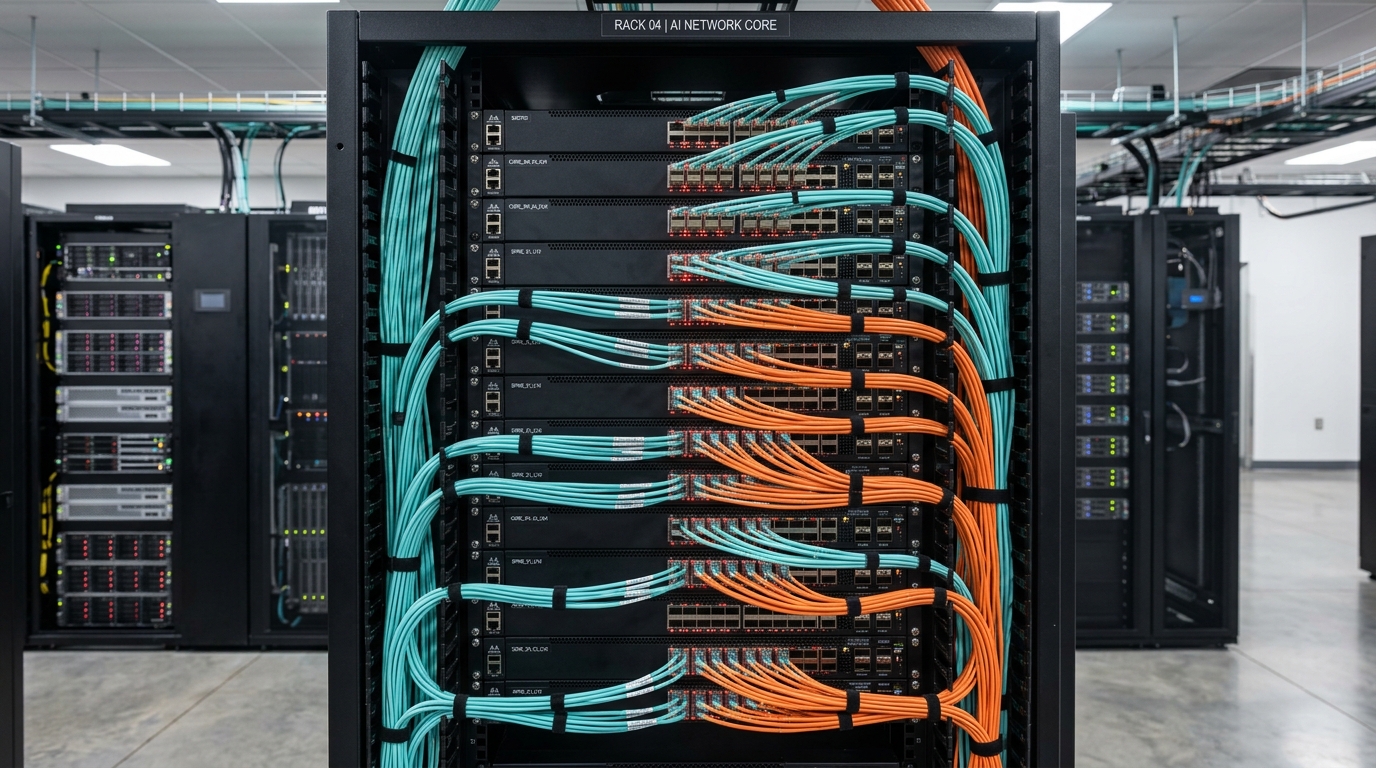
When training modern foundation models or executing distributed tensor-parallel inference across multi-GPU server nodes, compute power is rarely the sole limiting factor. Modern NVIDIA H100, H200, and Blackwell GPUs execute matrix multiplications so rapidly that GPUs spend up to 40% of their operational cycles idling in collective communication synchronization barriers (e.g., AllReduce, AllGather, and ReduceScatter).
To keep Tensor Cores saturated, inter-node networking must provide Remote Direct Memory Access (RDMA)—bypassing host CPU operating system kernel network stacks to transfer tensor weights directly from one GPU’s VRAM across the PCIe bus into a remote node’s GPU VRAM. Historically, InfiniBand was the unquestioned sovereign of high-performance computing (HPC) RDMA fabrics. However, the rise of open-source silicon and 100GbE/400GbE merchant switching silicon has transformed RoCEv2 into a formidable, cost-effective rival.
Can RoCEv2 Over 100GbE/400GbE Ethernet Match InfiniBand for Multi-Node AI Training?
The architectural divergence between InfiniBand and RoCEv2 centers on the physical and transport layer philosophy:
- InfiniBand (NVIDIA Quantum-2): A natively lossless, credit-based network architecture. A transmitting node will never emit a packet unless the downstream switch has already signaled that buffer space is reserved. This guarantees zero packet drops at the physical layer, delivering sub-microsecond switch latencies (~130ns) and deterministic collective communication. However, it requires proprietary cables, specialized Subnet Managers (OpenSM), and expensive proprietary switches subject to single-vendor supply allocations.
- RoCEv2 (RDMA over Converged Ethernet): Encapsulates IB transport packets inside standard UDP/IP Ethernet frames (UDP destination port 4791). This allows RDMA to run over ubiquitous, high-volume merchant Ethernet silicon (Broadcom Tomahawk, Cisco Silicon One, Marvell Teralynx). However, because native Ethernet is lossy, engineers must layer specialized flow-control protocols to synthesize artificial losslessness.
| Fabric Attribute | NVIDIA Quantum-2 InfiniBand (NDR 400G) | RoCEv2 over 400GbE (Broadcom Tomahawk 5) | RoCEv2 over 100GbE (Broadcom Tomahawk 3) | Standard TCP/IP over 100GbE (Kernel Socket) |
|---|---|---|---|---|
| Switch Cut-Through Latency | ~130 nanoseconds | ~450 – 600 nanoseconds | ~750 – 900 nanoseconds | 12 – 25 microseconds (Host CPU tax) |
| Lossless Transport Mechanism | Hardware credit-based flow control | PFC (802.1Qbb) + DCQCN / ECN | PFC (802.1Qbb) + DCQCN / ECN | TCP retransmission (Lossy) |
| NCCL All-Reduce Efficiency (% of Theoretical) | 98.2% | 95.1% – 96.8% | 92.4% – 94.5% | 38.0% – 52.0% (Severe bottleneck) |
| Switch Cost Per Port (2026 Street) | $1,850 – $2,400 / port | $950 – $1,300 / port | $280 – $420 / port | $220 – $350 / port |
| Vendor Lock-in & Ecosystem | High (Solely NVIDIA Mellanox) | Open (Arista, Cisco, Edgecore, SONiC) | Open (Whitebox switches, SONiC, Cumulus) | Universal standard |
Why Does RoCEv2 Require Priority Flow Control (PFC) and ECN Tuning to Prevent Deadlock?
When an RDMA receiver drops a single packet, the RoCEv2 Go-Back-N retransmission mechanism forces the sender to retransmit the entire transmission window. In an AI cluster executing a 100GB all-reduce tensor exchange, a single dropped packet causes milliseconds of GPU pipeline stall.
To eliminate packet drops on Ethernet, network architects must orchestrate three interdependent protocols:
- Priority Flow Control (PFC / IEEE 802.1Qbb): Divides the Ethernet link into eight virtual priority queues (typically reserving Priority 3 for RoCEv2 RDMA traffic). When a switch ingress buffer fills toward capacity, it emits a PFC PAUSE frame upstream, instructing the sending NIC to halt transmission for that specific priority class while leaving standard traffic untouched.
- PFC Deadlock Prevention: If two switches simultaneously pause each other in a multi-path Clos topology, a circular dependency occurs. Packets cannot forward because upstream queues are blocked, and queues cannot drain because downstream links are paused. To prevent cluster-wide freeze, switches must implement dynamic PFC Watchdog Timers that detect and recover from deadlocks within 10 to 50 milliseconds by selectively dropping the stalled flow.
- Explicit Congestion Notification (ECN / RFC 3168) & DCQCN: PFC is a blunt, reactive emergency brake. To prevent PFC from triggering in the first place, switches monitor buffer egress queues. When queue depth exceeds an ECN marking threshold (e.g., 20% of buffer capacity), the switch marks the IP header’s ECN bits (CE = Congestion Encountered). The receiving NIC detects the mark and returns a Congestion Notification Packet (CNP) to the sender, prompting the sending NIC to gracefully throttle its transmission rate before buffer overflow occurs.
How to Design a Non-Blocking Spine-Leaf Fabric for 64+ GPU Nodes
For on-premise AI infrastructure containing 64 GPU server nodes (e.g., 512 total GPUs across 8-GPU chassis), the network architecture must enforce a 1:1 non-blocking leaf-spine Clos topology:
- Compute Leaves (Top-of-Rack Switches): Each 8-GPU chassis is equipped with 8x ConnectX-6 Dx (100GbE) or ConnectX-7 (400GbE) PCIe NICs—one dedicated NIC per GPU to bypass inter-socket NUMA bus contention. Four 64-port 100GbE/400GbE leaf switches provide 32 downlinks to server NICs and 32 uplinks to the spine tier, guaranteeing zero oversubscription (1:1 bandwidth).
- Equal-Cost Multi-Path (ECMP) Hashing: Because RoCEv2 packets share identical source/destination IP addresses and UDP port 4791, standard Layer 3/4 switch hashing would route all packets down a single leaf-spine link, creating severe hash polarization. Network engineers must configure NICs to randomize the UDP source port based on the RDMA Queue Pair (QP) ID, enabling switches to distribute packets evenly across all spine links.
Frequently Asked Questions About RoCEv2 vs InfiniBand Networking
Is InfiniBand still faster than RoCEv2 for distributed training?
InfiniBand maintains a slight raw latency advantage (~130ns switch hops vs. ~500ns on RoCEv2) and superior collective hardware offloads (SHARP). For massive supercomputing clusters exceeding 1,000 GPU nodes, InfiniBand provides near-perfect predictability. However, for small-to-medium clusters (8 to 128 nodes), modern 400GbE RoCEv2 achieves 95%+ of InfiniBand’s training speed at dramatically lower capital cost.
Can I run RoCEv2 on existing corporate office Ethernet switches?
No. Standard enterprise campus switches lack deep packet buffers, RDMA-capable merchant ASICs, and hardware support for PFC (802.1Qbb) and ECN (RFC 3168). Attempting to run RoCEv2 on generic enterprise switching hardware results in severe packet drops, retransmission storms, and abysmal training throughput.
What network operating system (NOS) is recommended for RoCEv2 fabrics?
Open-source SONiC (Software for Open Networking in the Cloud) running on whitebox ODM switches (Edgecore, Celestica) is the dominant enterprise standard. Arista EOS and Cisco NX-OS also offer exceptional automated RoCEv2 tuning profiles and telemetry analytics for enterprise deployments.