
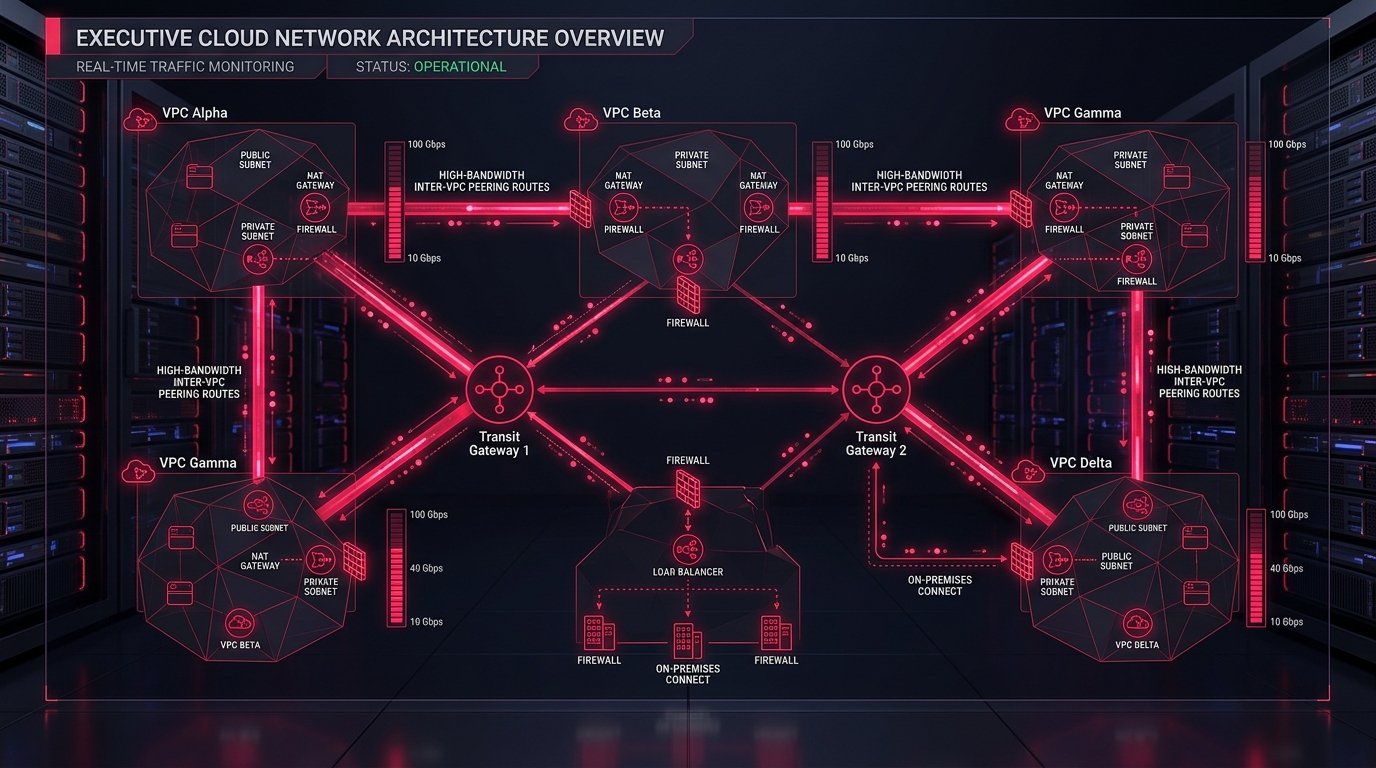
- The Transit Gateway Processing Toll: AWS charges an hourly attachment fee ($0.05/hr) plus a punitive $0.02 per gigabyte data processing fee on all transit traffic.
- VPC Peering Economic Advantage: Direct VPC Peering charges exactly $0.00 for data processing and $0.00 for hourly connections within the same Availability Zone.
- FinOps Threshold: For enterprise workloads pushing more than 25TB of inter-VPC traffic per month, direct VPC peering saves $18,000 to $120,000 annually over Transit Gateway hub-and-spoke models.
When enterprise cloud architects design multi-account AWS topologies, AWS solutions architects almost universally recommend AWS Transit Gateway (TGW). Promoted as the simplified “hub-and-spoke” network backbone, Transit Gateway consolidates thousands of VPC route tables into a centralized managed appliance.
However, beneath the architectural convenience lies one of the most predatory hidden billing traps in public cloud computing: the $0.02/GB data processing toll. When distributed microservices, Kafka pipelines, and analytics databases exchange high volumes of data across accounts, Transit Gateway invoices scale out of control. This connects directly with our forensic teardowns of AWS NAT Gateway pricing traps and cloud egress tax evasion with Direct Connect and Cloudflare.
The Cost Architecture: Why Transit Gateway Surcharges Explode at Scale
Transit Gateway charges $0.05/hour per VPC attachment ($36.50/mo per VPC) plus $0.02 per GB of data transferred through the gateway. Direct VPC Peering incurs zero hourly fees and zero processing fees. For 100TB of inter-VPC monthly transfer, Transit Gateway costs $2,000/mo in processing fees alone, whereas VPC peering costs $0.00 if within the same AZ.
Furthermore, if inter-VPC traffic traverses between different Availability Zones (e.g. from `us-east-1a` to `us-east-1b`), AWS adds standard cross-AZ data transfer charges ($0.01/GB in each direction) on top of the Transit Gateway processing fee, creating an effective $0.04/GB toll for every gigabyte routed through the network.
| Networking Architecture | Hourly Cost per VPC | Data Processing Toll | 100TB Monthly Ingress/Egress Cost |
|---|---|---|---|
| AWS Transit Gateway (TGW) | $0.05 / hr per attachment | $0.02 / GB transferred | $2,073.00 / mo (Processing + Attachments) |
| Direct VPC Peering (Same AZ) | $0.00 / hr | $0.00 / GB | $0.00 / mo (100% Free) |
| Direct VPC Peering (Cross AZ) | $0.00 / hr | $0.01 / GB in / out ($0.02 total) | $1,000.00 / mo (Saves 52% over TGW) |
The Hybrid Architectural Solution: Peering for Data, TGW for Management
Enterprise FinOps teams do not need to choose between an unmanageable mesh of thousands of peering connections and Transit Gateway’s crippling data tolls. The gold-standard 2026 architecture employs a strategic hybrid model:
- Low-Volume Management via TGW: Bastion access, internal developer tooling, CI/CD runners, and active directory queries route through Transit Gateway where aggregate data transfer is minimal.
- High-Throughput Peering Overrides: Dedicated VPC Peering connections are established between high-throughput data nodes (e.g. Kubernetes worker clusters to central ClickHouse or PostgreSQL databases). Static CIDR routing tables are updated to direct data traffic over the peering connection, completely bypassing the TGW processing meter.
- AZ-Aligned Workload Scheduling: Leveraging Kubernetes node-affinity rules to schedule chatty microservices within the same Availability Zone as their target database eliminates both cross-AZ data tolls and TGW processing fees.
People Also Ask: VPC Peering vs. Transit Gateway
Does VPC peering introduce latency compared to Transit Gateway?
No. VPC peering actually delivers lower latency than Transit Gateway. Peering connects VPCs directly across the underlying AWS hypervisor network with single-hop routing. Transit Gateway introduces an intermediate routing hop that typically adds 0.5ms to 1.5ms of round-trip network latency.
What is the route table limit for VPC peering?
A standard AWS VPC route table supports up to 1,000 routes. While this is sufficient for 95% of enterprise topologies, organizations managing tens of thousands of VPCs often use Transit Gateway to avoid hitting route table limits.
Can VPC peering connect across different AWS regions?
Yes. Inter-Region VPC Peering connects VPCs across different AWS geographic regions. While standard inter-region data transfer rates apply, AWS charges zero hourly attachment or processing fees for inter-region peering.
Transit Gateway is a classic AWS “convenience tax.” Cloud architects trade five minutes of Terraform routing configuration for a permanent, unyielding $0.02/GB toll on all inter-VPC traffic. Audit your AWS Cost Explorer network processing line items today. Deploy direct VPC peering across your top five data-intensive services, and you will instantly eliminate thousands of dollars in monthly cloud waste.