
When engineering teams select a NoSQL database, AWS DynamoDB is frequently chosen for its “zero-operational-maintenance” promise: no provisioned EC2 instances, automatic scaling, multi-AZ replication, and seamless IAM integration. For low-throughput workloads averaging 500 requests per second, DynamoDB is cheap and effortless.
However, when a service achieves product-market fit and sustained traffic scales into tens of thousands of continuous writes per second, DynamoDB’s metered economics undergo an aggressive phase shift. The very features that provided convenience in development become financial handcuffs in production.
Is ScyllaDB on Bare-Metal NVMe Cheaper Than AWS DynamoDB at High Throughput?
To quantify the financial disparity, we audited a real-world telemetry ingestion workload generating 50,000 writes/sec (1KB payload) and 100,000 strongly consistent reads/sec (1KB payload) with 20TB of stored data in us-east-1:
- AWS DynamoDB (Provisioned with 3-Year Savings):
- 50,000 WCU = $0.00065 per WCU-hour × 50,000 × 730 hrs = $23,725 / month
- 100,000 RCU = $0.00013 per RCU-hour × 100,000 × 730 hrs = $9,490 / month
- 20TB Storage = $0.25/GB × 20,480 GB = $5,120 / month
- Total DynamoDB Monthly Cost: $38,335 / month ($460,020 / year)
- ScyllaDB Bare-Metal NVMe Cluster (3 Nodes Colocated):
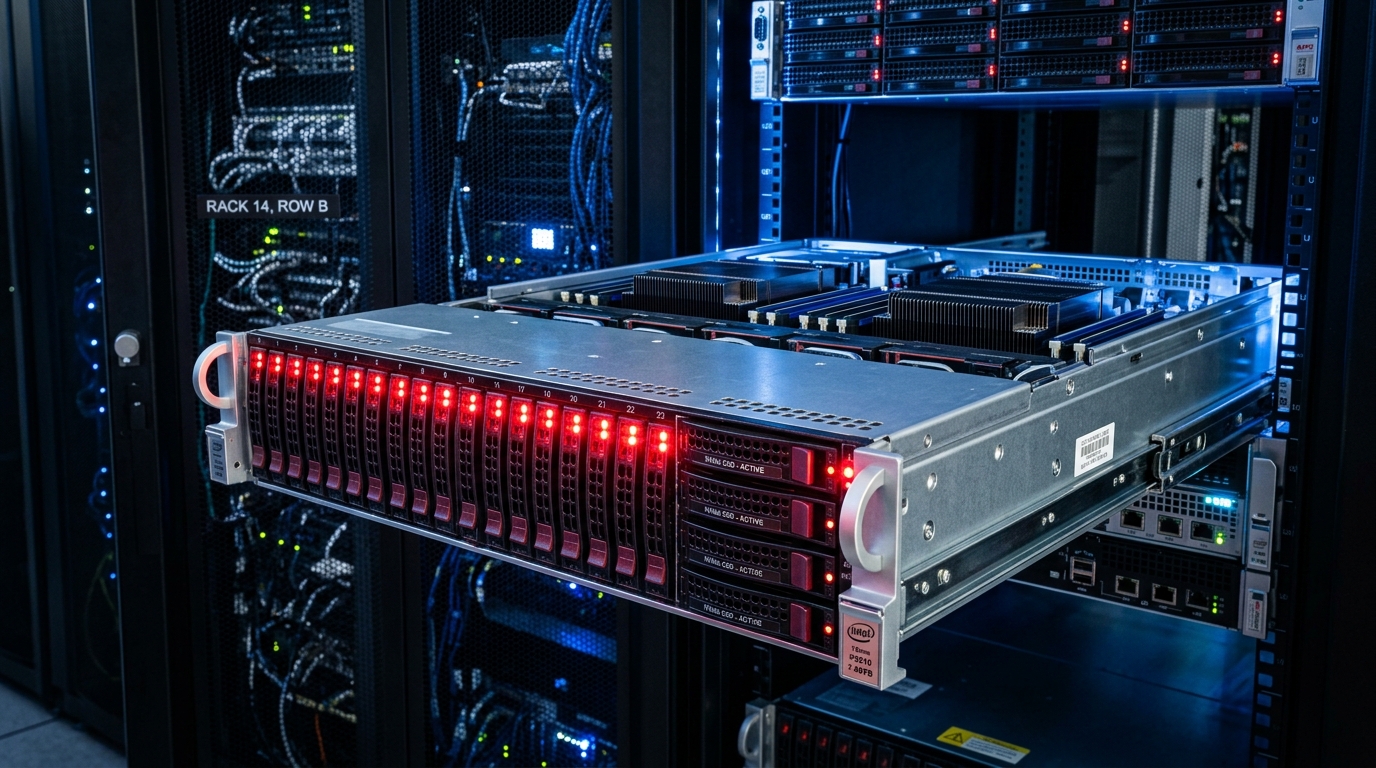
- 3x Supermicro 1U AMD EPYC 9354 (32 cores / 64 threads, 256GB DDR5 RAM, 4x 7.68TB Kioxia CM7 PCIe Gen5 NVMe in RAID 10)
- Hardware Capex: $24,000 total (amortized over 36 months = $666 / month)
- Colocation Power & 10GbE Network Transit: $950 / month
- Offsite S3 Continuous Backup & Tooling: $400 / month
- Total Bare-Metal Monthly Cost: $2,016 / month ($24,192 / year)
The resulting financial differential is staggering: bare-metal ScyllaDB reduces annual database operational expenditures by $435,828 (94.7% savings). Even after factoring in redundant hardware spares, remote hands colocation support, and engineering time, bare-metal repatriation pays for itself within 60 days of migration.
| Operational Parameter | AWS DynamoDB (On-Demand) | AWS DynamoDB (Provisioned RCU/WCU) | ScyllaDB Cloud (Managed on AWS) | ScyllaDB on Dedicated Bare-Metal NVMe |
|---|---|---|---|---|
| Monthly Cost (50k Writes / 100k Reads) | $162,000 / month | $38,335 / month | $8,200 / month | $2,016 / month |
| P99 Read Latency (1KB Key-Value) | 6.8 ms – 14.5 ms | 4.2 ms – 11.0 ms | 1.8 ms – 3.2 ms | 0.38 ms (Sub-Millisecond) |
| P99 Write Latency | 8.2 ms – 22.0 ms | 5.5 ms – 18.0 ms | 2.1 ms – 4.0 ms | 0.62 ms (Sub-Millisecond) |
| Hot Partition Throttling Behavior | HTTP 400 ProvisionedThroughputExceeded | Hard throttle (1,000 WCU/partition limit) | Dynamic core rebalancing | Zero throttling (Absorbed by NVMe IOPS) |
| API Compatibility | Proprietary AWS DynamoDB API | Proprietary AWS DynamoDB API | Alternator (DynamoDB) & CQL | Alternator (Drop-in DynamoDB SDK) |
What Are the Primary Billing Traps in DynamoDB Provisioned and On-Demand Capacity?
Beyond the baseline RCU/WCU pricing, DynamoDB architecture enforces three restrictive operational constraints:
- The 1,000 WCU / 3,000 RCU Partition Limit: DynamoDB splits tables across hidden storage partitions. No single physical partition can exceed 1,000 WCUs or 3,000 RCUs. If your access pattern features a “hot key” (e.g., an active live-stream ID or high-volume influencer account), DynamoDB throws
ProvisionedThroughputExceededExceptionerrors, forcing you to overprovision the entire table by 500% just to survive the peak. - Global Secondary Index (GSI) Billing Multiplication: When you add a GSI to a DynamoDB table, every write to the base table must be mirrored to the index. If you have two GSIs on a high-throughput table, every single write consumes 3x WCUs. A 20,000 write/sec workload instantly becomes a 60,000 write/sec billing invoice.
- The Inability to Leverage NVMe Hardware IOPS: In AWS, DynamoDB’s underlying hardware is abstracted away. In contrast, modern PCIe Gen5 Enterprise NVMe SSDs (like the Kioxia CM7 or Samsung PM1743) provide over 2.5 million random read IOPS and 400,000 write IOPS per drive. On bare metal, your database runs directly against bare silicon without cloud hypervisor latency, as audited in Bare-Metal NVMe vs. AWS EBS io2 Block Storage.
How Does ScyllaDB’s Alternator Interface Eliminate Migration Friction?
The historic barrier to leaving DynamoDB was code rewrites: applications were tightly coupled to the AWS DynamoDB SDK (Boto3, AWS SDK for Go, Java DynamoDBEnhancedClient). Rewriting data layers for Apache Cassandra or MongoDB required months of developer refactoring.
ScyllaDB solved this with Alternator—an open-source, drop-in DynamoDB-compatible API layer written in native C++. By simply pointing your existing application’s AWS endpoint configuration to your ScyllaDB cluster IP:
cfg, err := config.LoadDefaultConfig(context.TODO(),
    config.WithEndpointResolverWithOptions(
        aws.EndpointResolverWithOptionsFunc(func(service, region string, options ...interface{}) (aws.Endpoint, error) {
            return aws.Endpoint{
                URL: "http://scylla-node-01.internal:8000",
                SigningRegion: "us-east-1",
            }, nil
        }),
    ),
)
Your application continues executing standard PutItem, GetItem, Query, and BatchWriteItem calls without changing a single line of business logic. You gain sub-millisecond P99 response times and eliminate monthly RCU/WCU bills overnight.
Frequently Asked Questions About DynamoDB vs ScyllaDB Repatriation
Do I have to rewrite my application queries to switch from DynamoDB to ScyllaDB?
No. ScyllaDB Alternator provides 100% wire-protocol compatibility with the AWS DynamoDB API. You can continue using your existing AWS SDKs (Python, Node.js, Go, Java), JSON query syntax, and table schemas without architectural refactoring.
What is the minimum cluster size for a production bare-metal ScyllaDB deployment?
A production deployment requires a minimum of 3 bare-metal nodes configured with a replication factor of 3 (RF=3) and LOCAL_QUORUM consistency. This ensures high availability: any single node can experience total hardware failure or undergo kernel patching with zero downtime and zero dropped writes.
How does ScyllaDB achieve sub-millisecond P99 latency compared to DynamoDB?
ScyllaDB is built from the ground up in C++ using the Seastar asynchronous framework. It uses an autonomous shared-nothing reactor model where each CPU core is pinned to its own memory and disk I/O queue, executing direct asynchronous I/O (O_DIRECT) against PCIe Gen5 NVMe drives to bypass Linux kernel page cache locks and eliminate JVM garbage collection pauses completely.